
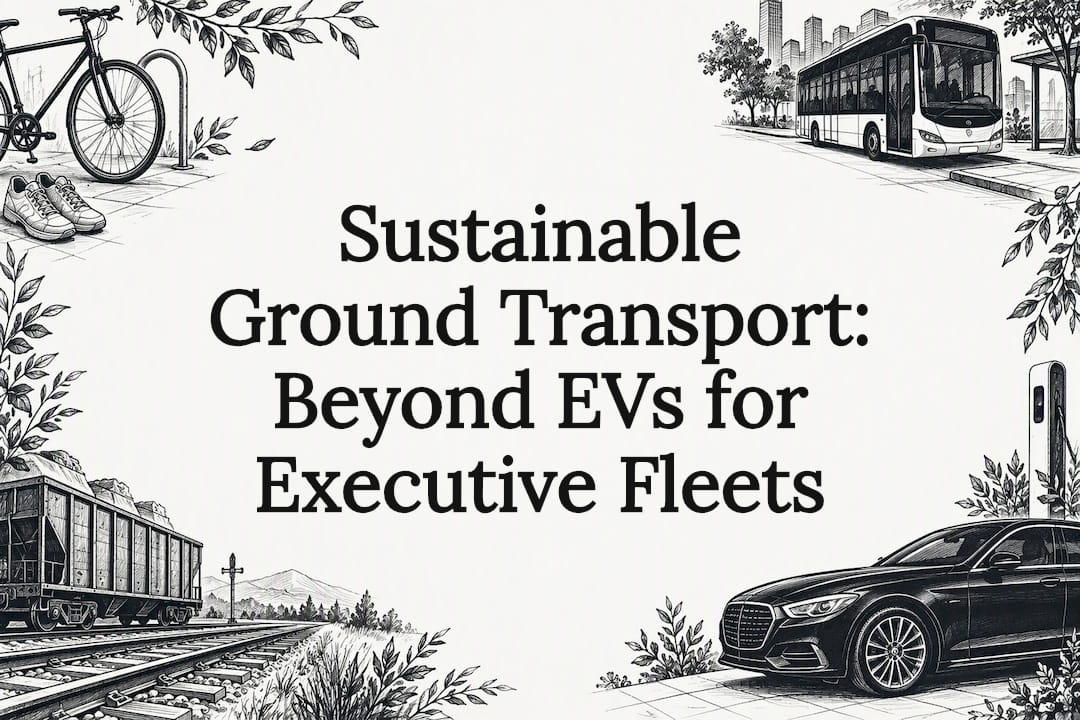
Sustainable ground transport is a systems approach that cuts emissions by avoiding unnecessary trips, shifting to low carbon modes, and improving vehicle efficiency. The two actions that matter most are moving more trips to walking, cycling, and public transit, and electrifying the vehicles that remain while powering them with clean electricity. The UN Department of Economic and Social Affairs ties this shift directly to multiple global development goals, not just emissions targets.
TL;DR:
- WHO estimates that replacing a daily car trip with cycling cuts annual CO2 emissions by about 0.5 tonnes, while walking and cycling suit short journeys.
- Public transit's emissions advantage depends on ridership: half empty buses lose much of their per passenger benefit, so route design and service frequency matter.
- Electric vehicles deliver greater lifecycle gains on cleaner grids, while heavily used fleets spread manufacturing emissions across more low emission miles.
- Cities should pair compact development with protected bike lanes and reliable transit, because electrifying fleets alone does not reduce car dependence or sprawl.
- For freight, rail and inland waterways emit far less per ton than long haul trucking; electrified trucks suit predictable shorter routes with dependable charging.
Table of Contents
- What Sustainable Ground Transport Means in Practice
- Why Sustainable Ground Transport Matters Now
- Key Ground Transport Modes and What Makes Each Sustainable
- Policy and Design That Make the Shift Possible
- Charging, Grids, and Fleet Operations Behind the Scenes
- Programs That Shift Everyday Behavior
- How Premium Chauffeur Services Fit the Sustainability Picture
- Innovations Reshaping Luxury Chauffeur Fleets
- Best Practices for Sustainable Premium Transport Operations
- Traditional Chauffeur Fleets Versus Sustainable Alternatives
- Technology Alone Will Not Fix Ground Transport
- A Lower-Emission Way to Book Executive Ground Transport
- FAQ
- Sources
What Sustainable Ground Transport Means in Practice
Sustainable ground transport is not a single technology. It is a combination of land use, infrastructure, vehicle operations, individual behavior, and fuel choices working together, which is why experts describe it as a systems problem rather than a product category. A faster electric car still sits in the same congested street grid; a denser neighborhood with safe sidewalks changes how many car trips happen at all.
The IPCC and UN sustainable development programs frame transport mitigation through a model known as Avoid, Shift, Improve, or ASI. Each category covers a different lever:
- Avoid: reduce the need to travel through compact land use, remote work policies, and mixed-use zoning that puts homes near jobs and services.
- Shift: move trips from private cars to walking, cycling, public transit, or rail freight instead of trucking.
- Improve: raise the efficiency of the vehicles and fuels still in use, from electric cars to cleaner buses and more efficient freight engines.
The UN's own framing stresses that technology alone cannot deliver a sustainable transport system. Infrastructure, policy, and behavioral change have to move together, because a fleet of electric vehicles stuck in sprawl still consumes land, energy, and time that denser, multimodal design would save. That systemic view is also why cities that only swap fuel types without changing street design or land use tend to see smaller gains than expected.
Why Sustainable Ground Transport Matters Now
Transport already accounts for a large and growing share of global energy-related greenhouse gas emissions, according to the UN Department of Economic and Social Affairs, and that share has been rising as vehicle ownership grows worldwide. The climate case alone would justify urgency, but the health and equity arguments are just as strong.
Switching one daily car trip to a bike can cut an individual's annual CO2 output by a substantial amount, according to the World Health Organization, which also found that cycling's life-cycle emissions per trip can run an order of magnitude lower than driving. Beyond carbon, the WHO ties active travel to lower rates of the chronic disease associated with sedentary commuting, better air quality near schools and homes, and more efficient use of urban space since a parked bike takes a fraction of the room a parked car does.
Equity enters the picture because low-income households are more likely to rely on walking, cycling, and transit already and are more exposed to roadway pollution and crash risk where that infrastructure is poor. Modal shift investments that make those existing choices safer and faster deliver outsized benefits to the people already using them, while easing congestion for everyone else.
Key Ground Transport Modes and What Makes Each Sustainable
No single mode solves sustainable mobility on its own. Each one fits a different trip length, density, and purpose, and a resilient system layers several together.
Walking and cycling remain the lowest-emission options for short trips. The WHO's health-benefits research credits active travel with measurable reductions in cardiovascular disease and improved mental health outcomes, on top of its emissions profile. The limitation is distance and weather exposure, which is why active travel works best paired with transit for longer legs.
Public transit, particularly bus rapid transit with dedicated lanes and urban or regional rail, moves far more people per lane of road than private cars do. Its sustainability depends on ridership: a half-empty bus loses much of its per-passenger advantage, so route design and service frequency matter as much as the vehicle itself.
Electric vehicles cut tailpipe emissions entirely and reduce lifecycle emissions wherever the electricity grid is relatively clean. The gains are largest for high-mileage fleets, since a vehicle driven heavily converts a fixed manufacturing carbon footprint into more low-emission miles. A study covered by Green Car Reports found that EVs used in ride-hailing and similar high-utilization fleets deliver proportionally larger carbon benefits than the same vehicle in private, low-mileage use.
Freight is the quiet half of ground transport. Rail and inland waterways move goods at a fraction of the per-ton emissions of long-haul trucking, and electrified trucking is advancing fastest on predictable, shorter routes where charging infrastructure can keep pace with duty cycles.
Micro-mobility, including e-bikes and cargo bikes, has become a practical tool for last-mile delivery in dense cities, cutting short van trips that otherwise idle in traffic.
Pro Tip: Match the mode to the trip rather than assuming one technology fits every journey; a five-minute errand and a cross-town delivery call for different answers.
Policy and Design That Make the Shift Possible
Large-scale modal shift rarely happens from individual choice alone. It takes planning and policy that make the low-carbon option the convenient one.
- Build compact, mixed-use neighborhoods so daily needs to sit within walking or cycling distance, a principle behind the "15-minute city" approach to urban design.
- Price road space and parking realistically through congestion charging and parking management, which shifts demand toward transit and active modes without banning cars outright.
- Prioritize transit-oriented development around rail and bus corridors so new housing and jobs locate where good transit already exists.
- Invest in protected bike lanes, reliable transit, and freight terminals that connect rail to last-mile delivery, rather than treating each mode in isolation.
- Manage fleet turnover deliberately. Research from IIASA warns that long-lived vehicles and infrastructure built around old assumptions create carbon lock-in, so policies that favor flexible, shorter-lived assets avoid locking in decades of avoidable emissions.
Coordinated public investment matters here. The European Commission's sustainable transport program points to funding mechanisms like the Connecting Europe Facility as central to building out charging networks and rail capacity at a pace that private investment alone would not reach.
Charging, Grids, and Fleet Operations Behind the Scenes
Electrification only delivers on its promise when the infrastructure behind it keeps up. Public charging comes in three broad tiers: slow overnight charging, faster public chargers for daytime top-ups, and ultra-fast chargers for highway corridors and high-turnover fleets. Coverage gaps and inconsistent plug standards remain real barriers to interoperability across regions.
- Smart charging and vehicle-to-grid technology let electric fleets draw power when the grid has surplus clean capacity and, in some cases, feed power back during peak demand.
- Mobility as a Service (MaaS) platforms combine transit, bike-share, and ride-hailing into one payment and trip-planning experience, making multimodal trips as easy to book as a single car ride.
- Fleet dispatch optimization reduces deadheading, the empty miles a vehicle drives between paid trips, which can quietly erase much of the emissions advantage of an efficient vehicle if occupancy rates run low.
- Charging aligned with duty cycles means scheduling top-ups around when vehicles are actually idle, rather than pulling them off the road mid-shift.
None of this works without clean electricity behind it. A fleet of electric vehicles charged from a coal-heavy grid delivers a smaller climate benefit than the same fleet charged where renewables dominate, which is why grid composition belongs in any serious sustainability conversation about electrification.
Programs That Shift Everyday Behavior
Infrastructure sets the ceiling on what is possible; behavior and incentives determine how much of that ceiling gets used.
- Employers can offer transit passes, telework flexibility, and incentives for walking or cycling to work, directly reducing single-occupancy commuting.
- Cities can subsidize e-bike purchases, expand bike-share networks, and adopt transit-first policies that give buses and trains priority over private cars at intersections.
- Communities that invest in street lighting, crossing safety, and traffic calming see higher rates of walking and cycling, since perceived safety is often the deciding factor for people who would otherwise drive.
- Monitoring programs that track modal-share changes and emissions over time let planners see what is working and redirect funding away from measures that are not.
These measures work best layered together rather than chosen one at a time, since a subsidized e-bike does little good on a street without safe places to ride it.
How Premium Chauffeur Services Fit the Sustainability Picture
Executive and delegation travel is a small slice of total ground transport, but the same efficiency levers apply to it. Real-time flight tracking lets a chauffeur adjust pickup timing to a flight's actual arrival instead of guessing from a schedule, cutting the idle time a vehicle spends circling or waiting at a curb. Route coordination across a fleet reduces deadheading between jobs, which research on fleet operations flags as a factor that can erase much of a vehicle's efficiency advantage if left unmanaged.
We apply operational practices such as employing vetted drivers and using real-time flight data to reduce fuel waste from idling at the wrong terminal at the wrong time.
- Vetted, trained drivers who understand routing and protocol reduce unnecessary mileage from wrong turns or miscommunicated pickup points.
- Consistent, well-maintained vehicles run more efficiently than an inconsistent mix of aging cars pulled from a general rental pool.
- Flight-aware dispatch matches vehicle readiness to actual arrival times rather than padded buffers that leave cars running longer than needed.
Pro Tip: Corporate travel managers comparing premium ground transport providers should ask specifically how dispatch and routing are coordinated, not just what vehicles are on the lot.
Innovations Reshaping Luxury Chauffeur Fleets
Electric and hybrid executive vehicles have moved from novelty to mainstream options in premium chauffeur fleets, driven partly by automakers extending electric and hybrid drivetrains into luxury sedan and SUV lines that match the black-on-black standard executive travel expects. The efficiency case is strongest for vehicles that log heavy daily mileage, since high utilization converts a vehicle's upfront manufacturing footprint into more low-emission miles over its service life, the same pattern Green Car Reports found in ride-hailing fleets.
Flight-tracking integration is itself a sustainability tool as much as a convenience feature. A chauffeur who knows a flight landed early or late can time departure precisely instead of idling at a curb or rushing to compensate, which trims fuel burn across a high-volume airport transfer operation. Route optimization software that accounts for live traffic plays a similar role, shaving miles and minutes off trips that would otherwise follow a fixed, less efficient path.
Charging infrastructure for executive fleets is advancing alongside public networks, though availability still varies significantly by city and airport, which is why fleet planning has to account for regional charging coverage rather than assuming uniform access. None of these innovations change the service standard clients expect. A hybrid or electric executive sedan still needs to arrive spotless, on time, and driven by someone who understands protocol, which is why fleet transitions in this category tend to move deliberately rather than all at once.

Best Practices for Sustainable Premium Transport Operations
Integrating sustainability into premium ground transport works best as an operational discipline rather than a marketing layer. The strongest practices focus on what actually reduces fuel use and idle time without compromising the reliability high-profile clients depend on.
Matching vehicle type to trip profile matters more than chasing a single fuel technology. A hybrid or electric vehicle suits high-mileage airport transfer routes well, while longer intercity hourly bookings may still call for a vehicle with the range and fueling flexibility to match the itinerary. Dispatch software that minimizes deadheading, the empty miles between paid trips, protects much of the efficiency gain a newer vehicle offers, since idle driving can offset a cleaner engine's advantage.
Driver training extends beyond etiquette and protocol into efficient driving habits: smoother acceleration, better route anticipation, and less unnecessary idling at curbs. Regular vehicle maintenance, including the diesel particulate filter service that diesel-inclusive fleets rely on, as Chapman's Automotive details for fleet operators, keeps emissions performance from degrading as vehicles age. Coordinating pickups around live flight data rather than fixed schedules rounds out the approach, cutting the curb-side waiting that otherwise burns fuel for no purpose.
Traditional Chauffeur Fleets Versus Sustainable Alternatives
A traditional, all-gasoline or diesel chauffeur fleet with fixed scheduling carries a heavier emissions footprint per trip than a comparable fleet built around electric or hybrid vehicles with flight-aware dispatch, largely because of two compounding factors: fuel type and idle time. Gasoline and diesel vehicles emit continuously at the tailpipe, while hybrid and electric vehicles cut or eliminate that output, with the electric advantage scaling further wherever the local grid leans toward renewables.
The dispatch factor often matters as much as the vehicle itself. A traditional fleet running fixed pickup buffers tends to idle longer at curbs and airports, while a flight-tracking-enabled fleet times arrival to the actual landing, cutting wasted idle minutes across hundreds of trips a month. Deadheading, the unpaid mileage between fares, erodes the efficiency gains of either fleet type if routing is not actively managed, which is why vehicle choice alone does not determine a fleet's real-world footprint.
For corporate and delegation travel specifically, the comparison extends to reliability. A sustainable alternative only delivers if it matches the security, punctuality, and protocol awareness that high-profile travel requires, since a lower-emission vehicle that arrives late or driven by an unvetted operator solves the wrong problem.
Technology Alone Will Not Fix Ground Transport
The dominant mistake in this conversation is treating electrification as the finish line. A country can hit ambitious EV sales targets and still fail on sustainable transport if sprawl keeps growing and transit keeps shrinking, because the car dependence itself is the deeper problem, not just what fuels the car.
The one action worth prioritizing, whether you are a commuter, an employer, or a city planner, is shifting at least one regular car trip to walking, cycling, or transit before reaching for a cleaner vehicle as the fix.
— Deep
A Lower-Emission Way to Book Executive Ground Transport
Corporate travel managers and delegation planners do not have to choose between reliability and a lower emissions footprint. We run real-time flight tracking across every airport transfer, which means fewer vehicles idling at curbs waiting on outdated schedules, and we coordinate routing across our network of vetted, protocol-aware drivers to cut the deadheading that erodes a fleet's efficiency gains.

For single pickups, our global airport transfers page details how flight-aware dispatch works in practice, and for recurring executive or delegation programs, our corporate chauffeur service page covers how we structure managed accounts across 90-plus countries. Request a quote today to see how a flight-aware, vetted fleet fits your next program.
FAQ
What are examples of sustainable transport?
Walking, cycling, public transit, rail freight, and electric or hybrid vehicles charged from a clean grid are the core examples. Micro-mobility options like e-bikes and cargo bikes also count, particularly for short urban trips and last-mile delivery.
What is the most environmentally friendly transport?
Walking and cycling are generally the lowest-emission options for short trips, since the WHO found that switching one daily car trip to a bike can cut an individual's annual CO2 by about 0.5 tonnes. For longer distances, high-capacity public transit and rail typically outperform private cars, including electric ones, on emissions per passenger.
What does sustainable transport mean?
Sustainable transport means moving people and goods in ways that are safe, affordable, and low-emission, achieved through a combination of land use planning, infrastructure, vehicle technology, and behavior change. The UN frames it as linked to multiple global development goals rather than a single environmental metric.
What are some sustainable solutions for transportation?
Solutions range from compact urban design and protected bike lanes to congestion pricing, electrified public transit, and fleet electrification paired with clean electricity. Programs like employer transit subsidies and Mobility as a Service platforms that combine transit, bike-share, and ride-hailing into one trip planner also expand uptake of lower-emission modes.
How does premium chauffeur service fit into sustainable transport planning?
Premium chauffeur services reduce avoidable emissions mainly through efficient dispatch and vehicle choice rather than by replacing public transit or active travel. We apply real-time flight tracking and coordinated routing across our fleet specifically to cut the idle time and deadheading that otherwise add unnecessary fuel use to executive and delegation travel.
Sources
- Sustainable transport | Department of Economic and Social Affairs
- 100 reasons to cycle and walk more (WHO)