
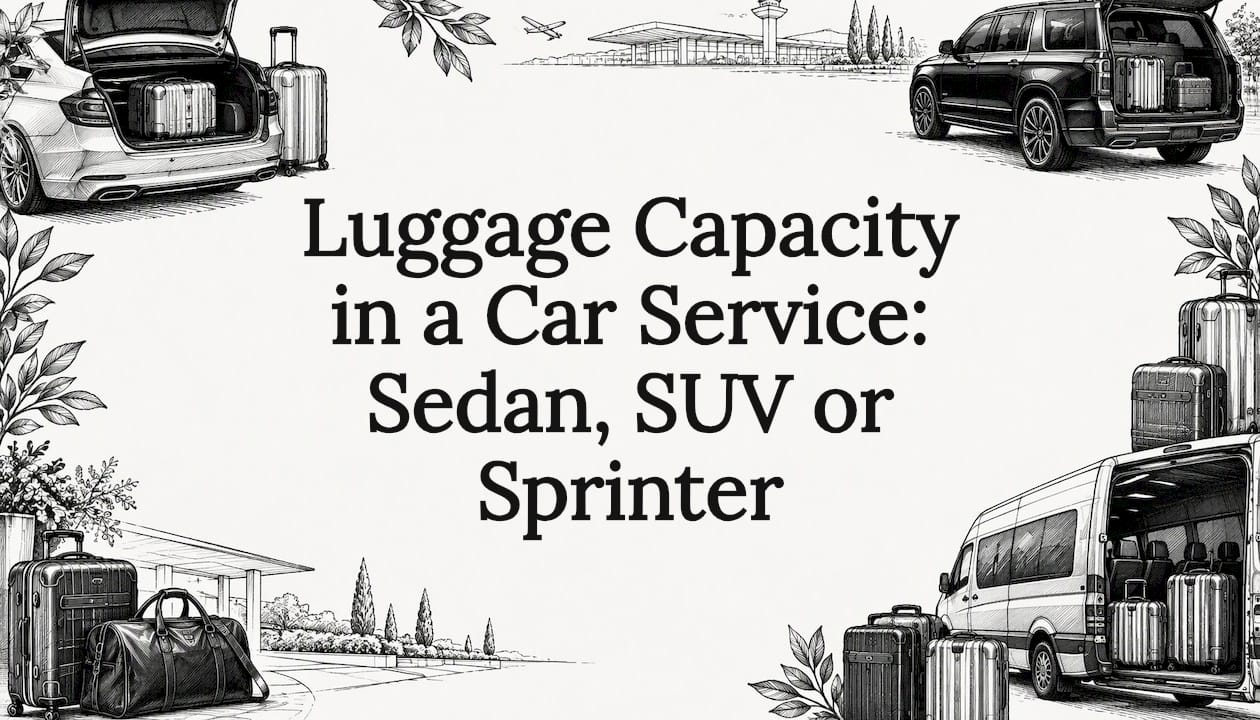
Book the vehicle for the bags first and the passengers second. A sedan is built around people, a full-size SUV carries a handful of checked bags only when the third row is folded, and a Sprinter-class van is the answer when a party has five or more travelers, several oversize items, or both. The mistake that costs executive assistants the most time is counting seats and forgetting that luggage capacity shrinks as soon as people sit in every row.
This guide shows how to read a capacity claim, what changes the number, how to plan for oversize items and why a trailer is rarely the right fix. It is written for people who coordinate principals, delegations and roadshows, where a bag left at the curb is a schedule problem, not an inconvenience.
TL;DR
- Luggage capacity depends on how many seats are occupied. Ask for the bag count with every row in use, not the number with the seats folded.
- A full-size SUV behind its third row holds far less than the same SUV with two rows. For a party of four or more with checked bags, step up to a larger SUV or a van.
- Bags are measured by size, not only count. A 26-inch checked roller is not a golf bag, a ski bag or a flight case.
- Give the booking desk the exact count, rough dimensions and any oversize items when you request the ride, so the vehicle is assigned for the load.
- When in doubt for a delegation, split the party across two matched vehicles or choose a van rather than relying on a trailer.
Table of Contents
- How car services describe luggage capacity
- What fits: sedan, SUV and Sprinter compared
- Count the bags the way an airline does
- Oversize luggage: what to settle before you book
- Luggage trailers: when they come up and what to check first
- Planning luggage for the people who actually book
- Our perspective
- Book the right vehicle for the load
- FAQ
- Sources
How car services describe luggage capacity
Most operators quote capacity as a count: "seats three, carries three bags." That shorthand hides three variables.
The seats in use. A number quoted for a vehicle with the rear seats folded is not the number you get with passengers aboard. Consumer Reports measures cargo room in SUVs and minivans with a pipe-frame box and counts suitcases behind the raised third row, because that is the real condition when every seat is filled.
The size of the bags. A count of "bags" assumes an average suitcase. Two midsize checked rollers take far more room than two carry-ons, and soft duffels pack differently than hard shells. The same volume figure can hold different numbers of suitcases depending on their shape.
The shape of the space. Cargo cubic feet describe volume, not usable floor. A deep, narrow well swallows a tall hard case poorly, while a wide, flat floor takes it easily. This is why a tall garment bag or a rigid equipment case can fail in a vehicle that looks big enough on paper.
The practical rule: ask for capacity with all passenger seats occupied, and give the vehicle count of bags by type, such as three large checked, four carry-on and one garment bag.
What fits: sedan, SUV and Sprinter compared
Exact numbers vary by make, model year and configuration, so treat the table as a planning guide and confirm the final assignment for your trip.
| Vehicle class | Typical party | Luggage logic | Best for |
|---|---|---|---|
| Executive sedan | 1 to 3 travelers | A few carry-ons and checked bags in the trunk; rear seat is not for bags | One principal with an assistant and light bags |
| Full-size SUV | 3 to 6 travelers | Generous with the third row folded, limited behind a raised third row | Principals with checked luggage, small teams |
| Executive van (V-Class style) | 4 to 7 travelers | Floor and rear space shaped for bags with seats in use | Small delegations, roadshow teams |
| Sprinter-class van | 8 or more travelers | Dedicated luggage area, capacity depends on seat layout | Delegations, groups, heavy or oversize loads |
Sedans
A sedan trunk is a fixed box. It takes a couple of checked suitcases and a few soft bags, and the cabin is meant for people. For one executive with one checked bag and a laptop case it is the quiet, discreet choice. Add an assistant with a second checked bag and a garment bag, and you are close to the limit. Our Private Sedan Service is the fit for a solo principal or a pair on a short trip.
SUVs: the third-row trap
Full-size SUVs look huge, and they are, until the third row is raised. The numbers show the gap. Chevrolet lists 41.5 cubic feet behind the third row of a Suburban and 25.5 cubic feet for the shorter Tahoe, according to a published luggage test of the Suburban. That difference alone decides whether a party of six keeps its bags aboard.
Independent testing shows how modest the count can be on standard three-row SUVs. In Consumer Reports' 2025 measurements, the Lexus TX and Chevrolet Traverse each fit three suitcases behind the raised third row. Three bags is a good number for three travelers. It is not a number for a party of six on a roadshow.
The rule that follows: in a full-size SUV, plan on the third row for people or for bags, not both. If you have two principals and an assistant, two rows are enough and the rear is free for luggage. For four or more with checked bags, move up a class. Our Private SUV / V-Class Service covers the middle ground.
Vans and Sprinters
A Sprinter-class van changes the equation because the luggage is not competing with seats on the same floor in the same way. Many passenger configurations put the bags behind the last row or in a separate area. The seat layout still decides how much that is: a 12-seat van and a 9-seat van built on the same chassis carry very different loads, and a van configured for comfort with fewer seats leaves far more room.

If your delegation is five or more people with heavy bags, several oversize items or a mix of both, a van is the sensible default rather than a stretch. For a deeper look at how the classes differ, see our guide to choosing between a sedan, SUV/V-Class and Sprinter.
Count the bags the way an airline does
Car services and airlines both think in sizes, so use the airline's own language to describe the load. Airlines generally define a standard checked bag by total linear inches, the sum of length, width and height. Most major U.S. carriers set that limit at 62 inches and 50 pounds for a standard checked bag, with heavier or larger bags charged extra and some premium cabins allowing more weight.
That gives you a simple shorthand for the booking: a "standard checked bag" is up to 62 linear inches. Anything beyond that, such as a long equipment case or a large trunk, is oversize for ground transport too, and the vehicle should be chosen with it in mind.
A tidy way to brief the desk:
- Number of travelers.
- Checked bags, with the largest dimensions.
- Carry-ons and garment bags.
- Oversize or fragile items (golf, ski, instrument or equipment cases, display materials).
- Whether the bags travel with the party or are sent ahead.
Oversize luggage: what to settle before you book
Oversize items are where capacity claims fall apart, so settle them before the ride, not at the curb.
Measure and weigh. A rough length and weight is enough. A four-foot hard case behaves differently from two soft duffels of the same weight.
Say what it is. A ski bag, a golf set, a camera case and a boxed presentation display each load differently. Naming the item lets the vehicle be matched, and a van or large SUV with a flat floor will take a long case that a sedan trunk cannot.
Count the whole party's items, not one person's. For an executive roadshow the large items often belong to the team, such as display cases, demo gear and printed materials. Total them across everyone riding.
Decide whether the seats stay up. If a long item needs a folded seat, that seat is no longer available for a passenger. Recount seats after you place the oversize item, not before.
Consider a second vehicle. Splitting a delegation across two matched vehicles often beats forcing everything into one. It also protects the schedule: if one party is delayed at customs, the other is not held. Our guide to group ground transportation logistics covers how to divide a larger party.
Transportation booking sites in other regions use the same logic of matching bag dimensions to vehicle class, as seen in taxi booking by vehicle size, so the same briefing habit works wherever the delegation travels.

Luggage trailers: when they come up and what to check first
A luggage trailer is a small towed cargo unit. It sometimes comes up when a group has more bags than any single vehicle can take. For executive and diplomatic travel it is usually the wrong tool, for practical reasons you can check yourself.
- Discretion and arrival. A trailer changes the look of a vehicle at a hotel entrance, an embassy gate or an FBO ramp, where a clean, low-profile arrival matters.
- Access. Terminal curbs, hotel porte-cocheres and parking structures can be tight, and a trailer limits where a vehicle can stop or turn.
- Security. Bags in an open or separate cargo unit are less controlled than bags kept inside the vehicle under the driver's eye.
- Rules. Towing requirements vary by state and country, so any plan involving a trailer needs confirming for the exact route and jurisdiction before the day.
For these reasons the cleaner answer is nearly always a larger vehicle or a second vehicle. A van keeps the bags inside, in one controlled space. If you believe your trip genuinely needs a trailer, raise it when you request the booking, with the full bag list, so the right solution is worked out before travel and not at arrivals.
Planning luggage for the people who actually book
Executive assistants coordinating several principals
The most common failure is booking per person instead of per load. Build one manifest for the whole movement: names, flights, bag counts, oversize items. Then choose vehicles from the manifest. When two principals arrive on different flights, assign a vehicle to each flight rather than combining them, because the live arrival time moves with each flight.
Government officials and diplomatic delegations
Delegations travel with bags that are heavy, numerous and not always standard: ceremonial items, gifts, document cases, equipment. Count them early and plan for a van or paired vehicles. Keep sensitive cases in the passenger cabin or in a space the driver controls. For a visiting delegation with a formal program, our Group & Delegation Transport service is built around exactly this kind of movement.
Tech leaders and finance executives on tight schedules
Roadshows mean several cities in a few days, often with the same bags, and little tolerance for a repack at the curb. Choose a vehicle that holds everything with all seats occupied so there is no second trip. When the day is a string of meetings and flights, an hourly as-directed booking keeps the same vehicle and the same bags together between stops, so luggage stays aboard rather than being unloaded at each one.
Private aviation arrivals
Private-jet passengers often bring more than commercial limits would allow, since the bags go straight from aircraft to vehicle. That makes capacity matter more, not less. The load that fits an airline's hold may not fit a sedan trunk. See our explainer on FBO and private-jet ground transfers for how the handoff works.
Our perspective
Luggage is where a car-service promise is tested. A vehicle can be spotless and the driver impeccable, and the trip still fails if the bags do not fit with the party aboard.
That is why we think about the load before the vehicle. A principal who steps off a flight wants the car at the curb, the bags in the car and the schedule intact. We run black-on-black, late-model vehicles with vetted, protocol-aware drivers, and flight tracking lets the chauffeur adjust the pickup to the live flight, so the vehicle is there when the bags are.
Our advice to assistants is simple: give the full picture at booking, with the number of travelers, the bag count and any oversize item, and let the vehicle be matched to the load. A single global desk makes that conversation the same in every city, which matters when the same delegation lands in several countries on one trip.
The principle holds whether the party is one executive or a full delegation: choose capacity with room to spare, keep the bags inside the vehicle, and keep the arrival quiet.
Deep
Book the right vehicle for the load
Chauffyr provides executive black-on-black chauffeur service across 500+ airports in more than 90 countries, with sedans, SUVs and group vehicles, real-time flight tracking and a 24/7 global desk. For airport arrivals with luggage, start with Global Airport Transfers. For a team, a delegation or a heavy load, see Private Group Transportation, or talk to us through the Chauffyr site about a program built for your travelers.

When you request a ride, send the traveler count, the bag list and any oversize items together, so the vehicle is assigned for the whole load from the start.
FAQ
How many suitcases fit in an SUV with passengers on board?
It depends on whether the third row is in use. With a third row raised, independent testing found that popular three-row SUVs such as the Lexus TX and Chevrolet Traverse fit three suitcases behind it. Longer full-size SUVs have more space behind the third row. For four or more travelers with checked bags, a larger SUV or a van is the safer plan.
What is the best vehicle for a group with a lot of luggage?
A Sprinter-class or executive van is usually the best choice for five or more travelers with checked bags or oversize items, because the luggage space is separate from the seating. Seat layout changes the capacity, so state the exact bag list when you book. Our vehicle comparison guide explains the differences.
How do I book a car service for oversize luggage?
Tell the booking desk what the item is, its approximate length and weight, and how many people are riding. Golf bags, ski bags, instrument cases and equipment cases each need a different vehicle layout. Giving this at the time of the request lets the vehicle be matched before travel, not at pickup.
Can a car service use a luggage trailer?
A trailer is occasionally discussed for very large loads, but for executive and delegation travel a larger vehicle or a second vehicle is normally cleaner, quieter and more secure. Towing rules vary by location, so raise the question with the full bag list when you request the booking.
What counts as a standard checked bag?
Most major U.S. airlines treat a standard checked bag as up to 62 linear inches and 50 pounds. Using the same terms in your booking helps the vehicle be matched to your bags.
Sources
- Consumer Reports: Cargo Room Actual Measured Space for SUVs and Minivans
- Autoblog: Chevrolet Suburban Luggage Test
- Checked Luggage Size Guide for U.S. Airlines
- Taxi booking by vehicle size